Hi, this is Henry. If you're interested in similar problems, I'd love to chat
An Energy Based Framework for Population Modeling
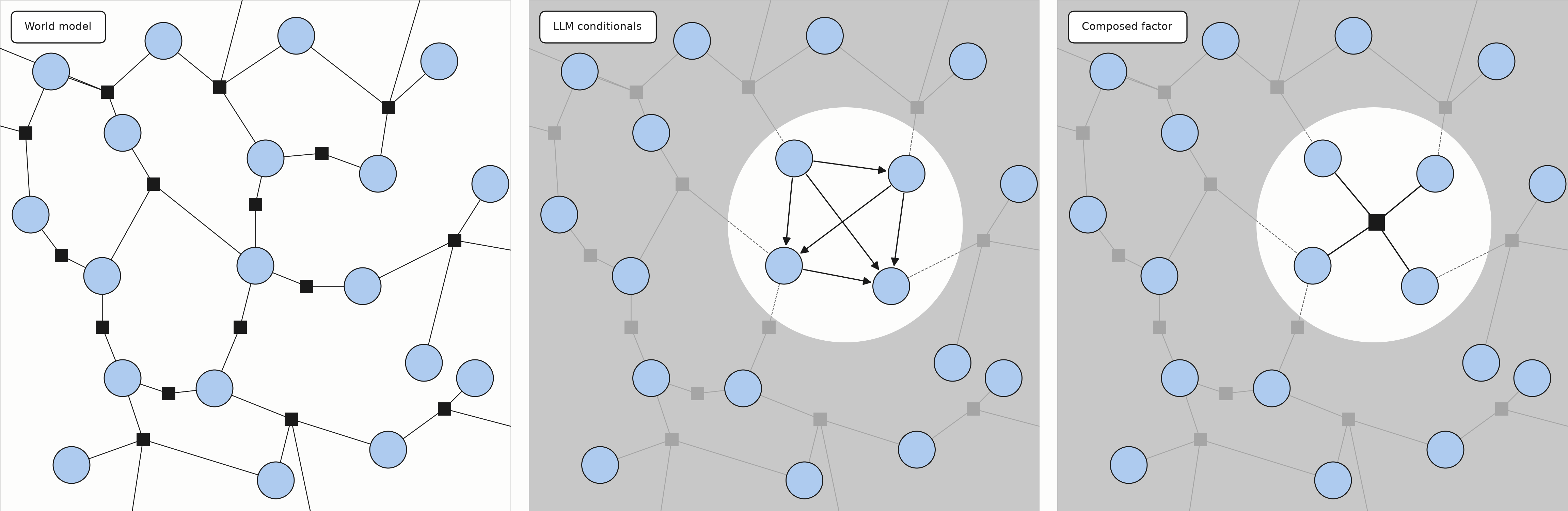
Treating the LLM-derived joint as an energy lets us compose partial models of individuals into one population distribution, impose macroscopic conditions as external fields, and read the population's remaining properties from its equilibrium.
Distilled-Conditional Bayesian Networks
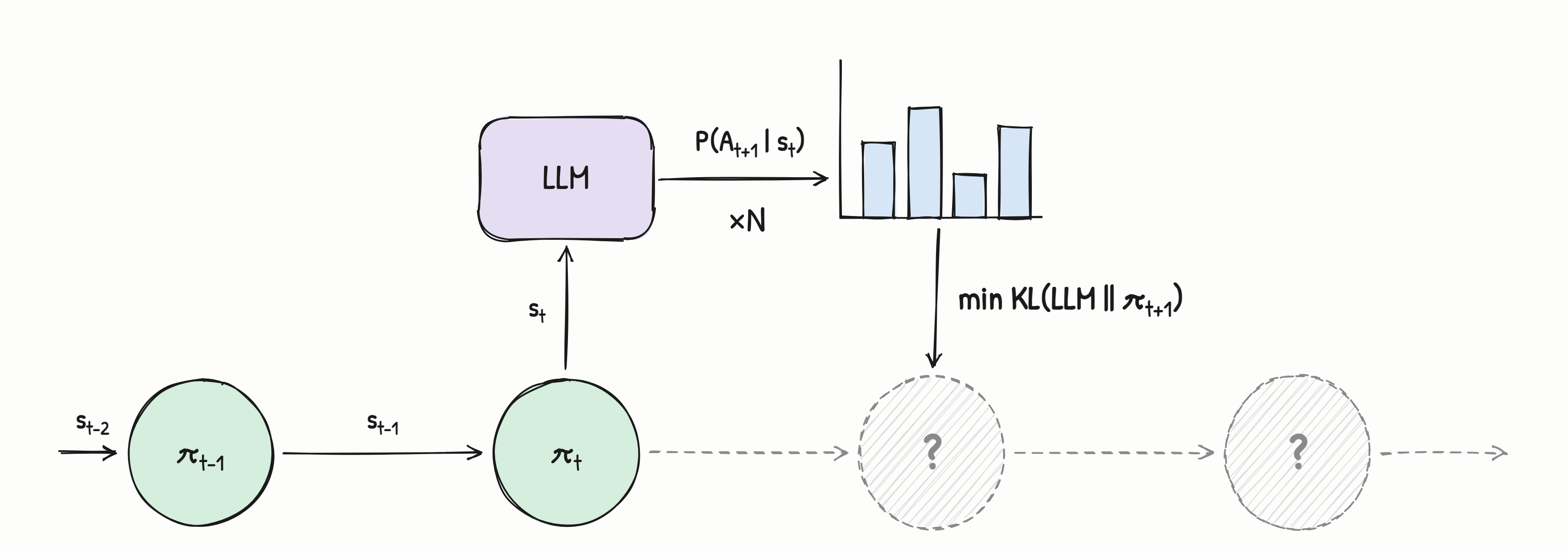
LLMs supply conditional structure but make poor coherent generators. We distill their conditionals, node by node, into an offline Bayesian network that generates arbitrarily large coherent synthetic populations after a one-time distillation cost.
Use the LLM to Build Your Simulator, Not to Be Your Simulator
LLM-based population simulation usually means sampling personas at inference time. We distill the LLM's response surface into a small log-linear model once, calibrate its absolute rates against observed toplines, and answer every later subgroup question offline.
The Mechanism Boundary in Automated Research
Automated research systems need more than better agent orchestration. Here, we argue that their reliability depends on where the research process can be made mechanically checkable, and what machinery can be built into the systems to take advantage.
The Architecture of Mechanized Research
SMAI separates agent reasoning from scientific verdicts by turning experiment designs into mechanically checkable commitments before any results are observed
SMAI: Scientific Method as Infrastructure
Auto-research agents can explore solution spaces faster than humans. But purely agent-driven approaches lose the structural rigor that pre-defined environments provide: methodology drift, post-hoc selection, inferential breakdowns. Structural verification provides the scaffolding that lets scaled systems be trustworthy.